It’s startling to think that I’m really this old. Only one year shy of reaching the milestone age of 70! How? When? Why? WTF?
I can’t say that there haven’t been recent warning signs:
- Arthritic joints, both osteoarthritis and rheumatoid.
- Extremely slow recovery times after anaerobic strength training sessions.
- Loss of muscle mass despite consistent power training combined with increased protein intake.
- A right shoulder so depleted by osteoarthritis that two orthopedic specialists have recommended replacement.
- Increasing number of gray hairs, facial wrinkles and skin tags.
- Depleted vision with minor cataract development.
- Constant annoying health surveys from Medicare, wondering if I’ve fallen recently, or if I need help with dressing, meal preparation and transportation.
- Etc, etc.
I recently read an article on sciencealert.com about a study on the effects of aging. Geneticist Michael Snyder of Stanford University states, “We’re not just changing gradually over time; there are some really dramatic changes. It turns out that mid-40s is a time of dramatic change as is the early 60s. And that’s true no matter what class of molecules you look at.”
In a way, I feel I’ve been lucky to have avoided, for the most part, that first dramatic change period. I’ve been equally lucky to have pushed the early 60s period to the mid-60s. Nonetheless, it seems to be hitting me now like a fast moving freight train.
At this juncture, it would probably be easier to describe the parts of physical me that are functioning without some amount of pain or discomfort. For instance, my left ear lobe feels fine. Plus, I still have my teeth and most of my hair. Bonus! A wise and optimistic friend shared this profound advice, “Pain is a reminder of being alive.” Every morning I awake and embrace this simple truth; I’m in pain, I’m alive!
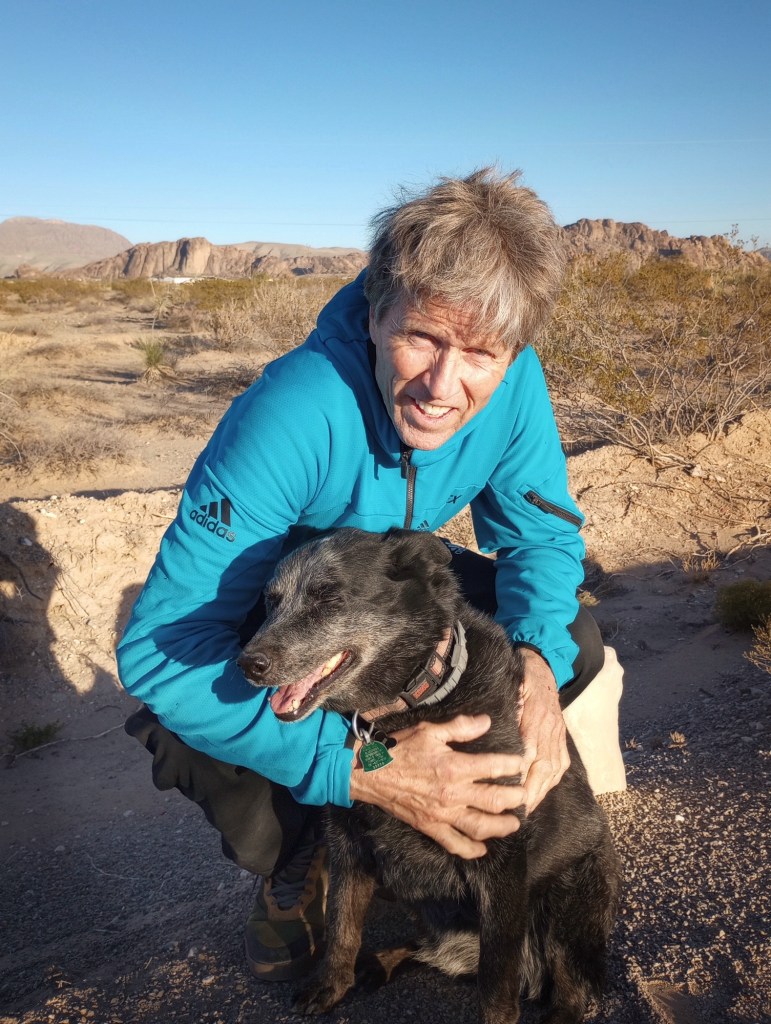
As an active member of the geriatric class, I have discovered a few important daily lifestyle rituals that work for me. I typically begin my day slowly, first checking to see what physical systems are functional. This is usually precipitated by our dog Lola and her need for attention. She starts with a subtle whine at six am. She’s a trustworthy alarm clock. I address her attention deficit with few minutes of scratch and pet while continuing my personal waking process.
The morning gently progresses with the coffee ritual, which calls for a strong brew, vis-a-vis grinding whole bean Italian roast for 13 seconds using our GoalZero Yeti 500. The finished grind goes into a couple of number two cone filters on top of our favorite porcelain mugs. The pour-over method is time consuming, and yet gratifyingly meditative.
Once my system is sufficiently caffeinated, I start the physical portion of my day by warming up my shoulders with 20 minutes of isometric exercises. This helps warm up and strengthen the multitude of tendon and muscle tissue surrounding my deteriorating shoulder joints.
Breakfast comes next and varies depending on the activity planned for the day. If it’s Monday, Wednesday, or Friday, we hope to be climbing or bouldering. Since it’s currently winter and we’re in Hueco, it will be bouldering. Breakfast options are old fashioned oatmeal, muesli or steel cut oats, mixed with PhysiVantage weapons grade whey protein, a cup of Greek yogurt, skim milk and almonds. Yummy!
I follow up a day of climbing with light strength training: weights, core, dead hangs, ring pushups, etc. Rest days are “restful” and typically involve active recovery like yoga, light core strengthening, walking/hiking, and stretching. Anything to keep the worn joints lubricated, otherwise I’ll feel like the rusty Tin Man from the Wizard of Oz after a rain.
Despite the discomfort of chronic arthritic pain, I still have a strong passion to climb, which I’ve maintained for 46 years now. It began with enrolling in a six week long wilderness course in the Teton mountain range of Wyoming when I was 23 years young. Before the end of the first week, I was hooked. By the end of the course, I had learned just enough to somehow avoid killing myself…barely.
My first couple of decades as a climbing athlete were spent pursuing esoteric goals on a multitude of mountains and rock walls. Eventually, I would settle on single pitch sport climbing, perhaps even more abstruse. This has been my passion for the past 30 years. I love the athleticism of negotiating steeply overhanging terrain, and embrace the redpoint process as if it were the very essence of life. When you factor in the variety that comes with our transitory lifestyle, I am, without doubt, experiencing my personal version of heaven on earth.
I’m thankful to have an amazing partnership with Maggie for the past decade and a half. Our shared lifestyle, goals, dreams and desires are so eerily similar that we find it easy to embrace living in the moment. Being simpatico with her is a definite plus for me as an aging athlete. Now that I’m starting to slow down, she’s more than willing to pick up the slack and often more than happy to put the draws on for me. ¡Mi encanta, mi esposa!
I think it’s natural and incredibly important to occasionally contemplate death at this point of my existence. It’s an integral part of life that everyone will experience eventually. The final chapter should not be feared. If we’ve been living passionately, the last breath should come without trepidation. Even though I’m unsure of when or how the final moment will manifest, I’m cognizant of the fact that the majority of my life is behind me. My focus tends toward the quality of life remaining, however near or distant that might be. Living in the moment is more important than it has ever been.
Although the physical me is declining, I take solace in the wisdom gained. Life is an evolutionary process, one that I will continue to embrace, albeit at a slightly slower pace. Sure, I’m a little broken, but doing fine for being 69.
–Chuck
A couple things: 1. Although we’re not professional photographers, the pictures we take and use are, well, ours. Friends and readers are welcome to repost them on Facebook or other personal social media accounts, but please ask if your intention is to use them for any sort of business or product promotion outside of our established relationships. We post photos taken by others with their permission, which you should also obtain if you wish to use them. 2. The ads on this site show up because we’re too frugal to pay enough to make them go away. They’re not necessarily for anything we endorse or support.
 The Gravity Chronicles
Happy birthday Chuck! And please, please, please write a book! 🙏 Hannes
LikeLike
Hi, as an older climber (but no where near in your leagues grade wise!) I am super inspired by both of you. My partner and I are I guess what you would call dedicated recreational climbers. We would be very interested in a post that deals with your experiences in managing/balancing climbing fatigue. We are struggling a bit to balance the required “gym strength training” to stay strong enough to do the climbs we want to, our recreational indoor climbing and our outdoor sessions. Along with some cardio etc to avoid dropping dead, and the stretching to keep mobile.
It would be great to get your insights into things like rest days; do you stack a number of activities in a day, and then take more rest; or is it best to spread things out as much as possible? When climbing outdoors for extended periods, how many days do you climb for before resting? Have you shortened the individual climbing day? etc.
Thanks so much, Stephen
LikeLike
Hey Stephen, these are all excellent questions! Finding the balance between too much or not enough training/climbing time and effort is incredibly challenging. I will work on getting a blog post together regarding my personal ideas and discoveries on this topic, ASAP. Thanks for the inspiration!
Briefly…
— I’m a firm believer in under-doing more than over-doing when it comes to climbing/training at my advanced age. We climb or train power three times a week, typically M/W/F. Sometimes following up a day of climbing with strength training if we’re not exhausted.
— On rest days, we do Ashtanga yoga, some light core training and/or easy walks or hikes.
Anything to promote active recovery.
— I like to incorporate climbs or training methods that are enjoyable to me, thus making it sustainable!
Stay tuned for a training blog soon and have a fantastic 2025, Stephen!
—
LikeLike
Awesome thank you. I really look forward to that.
Not over-doing it, and keeping it sustainable, makes a great deal of sense!
Have a great 2025. And thank you for the blog. This really is a unique perspective – I really look forward to the new posts.
LikeLiked by 1 person